How to Specify Sustainable Roller Blind Fabrics
A sustainable roller blind fabric should be assessed across its full specification, including what it is made from, how it is manufactured, how long it is likely to last, how it performs in use and what happens to it at the end of its service life.
Useful indicators can include recycled or renewable content, PVC-free construction, low chemical emissions, recognised environmental certifications and supporting lifecycle information.
You also need to consider how the fabric performs within the building.
Solar control, glare reduction, light transmission, openness, fire performance and durability can all affect whether a fabric is suitable for your project.
You can also explore our range of eco-friendly blind fabrics for current material and certification options.
What Makes a Roller Blind Fabric Sustainable?
When you assess the sustainability of a roller blind fabric, look at the full specification rather than a single claim or certification.
Key areas to review include:
- Raw materials: Is the fabric made from virgin, recycled or renewable material?
- Chemical composition: Does it contain PVC, phthalates or other substances that may be restricted or avoided on the project?
- Manufacturing: What information is available about energy use, waste, water use and production methods?
- Indoor air quality: Has the fabric been tested for chemical emissions or harmful substances?
- Performance: Does it provide the solar control, glare reduction, light transmission and privacy the building needs?
- Service life: How durable is the fabric and how often is it likely to need replacing?
- End of life: Can the material be recycled, recovered or returned through a manufacturer take-back scheme?
These factors help you compare products on a more useful basis and provide clearer evidence when sustainability requirements form part of the project brief.

What Types of Sustainable Blind Fabric Are Available?
Sustainable blind fabrics can use different material strategies.
The right option will depend on your project requirements, including environmental targets, solar performance, fire performance, durability and appearance.
Recycled polyester
Some roller blind fabrics use polyester made partly or wholly from recycled PET, often from post-consumer plastic.
This can reduce demand for virgin raw materials and provide a useful option where recycled content forms part of the project brief.
Renewable or bio-based materials
Some fabrics use polymers made from renewable plant-based feedstocks rather than relying entirely on fossil-derived raw materials.
These materials can support projects looking to reduce dependence on conventional petrochemical sources, but the full product specification still matters.
Check how the material is produced, how durable it is and whether any independent certification or lifecycle information is available.
PVC-free fabrics
PVC-free roller blind fabrics are available for projects where material composition and indoor environmental requirements are important.
When reviewing these fabrics, check what material has been used instead, whether low-emission or harmful-substance testing is available and whether the fabric still meets your requirements for fire performance, solar control and durability.
Recyclable fabrics
A recyclable fabric is designed so that its material can potentially be processed and used again at the end of its service life.
The practical recycling route matters. Ask whether an established recycling or take-back scheme exists and whether the fabric can be separated from coatings, backing materials and other components.
Recycled, renewable and recyclable mean different things
These terms describe different parts of a product’s environmental profile.
- Recycled refers to material that has already been used and processed into a new product.
- Renewable refers to material sourced from resources that can be replenished, such as plant-based feedstocks.
- Recyclable refers to what may happen to the material at the end of its useful life.
A fabric can meet one of these descriptions without meeting the others, so it is worth checking the technical data rather than relying on a single environmental claim.

Recycled Polyester Blind Fabrics
Recycled polyester can reduce demand for virgin polyester while providing the dimensional stability and durability required for many commercial blind applications.
The recycled content is often produced from post-consumer PET, such as plastic bottles, which are cleaned, processed and converted into new polyester fibre.
When comparing recycled polyester fabrics, check:
- whether the recycled content is independently verified
- openness factor and light transmission
- available environmental certifications
- durability and cleaning requirements
- the percentage of recycled content
- solar reflectance and absorption
- fire performance
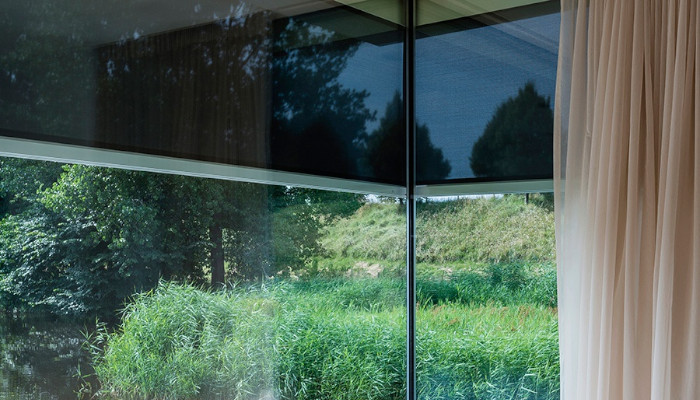
Our Envirotech Soprano range is one example of a fabric designed around recycled material content while still providing the solar and visual performance required for commercial interiors.
Envirotech Soprano
Soprano is Cradle to Cradle certified and made from 100% recycled PET bottles, delivering outstanding solar control with a responsible footprint.

Envirotech Soprano Metal
Made from 100% recycled PET bottles and C2C certified, this fabric delivers low solar transmittance and high solar reflectance, helping you maintain cooler interiors.
Plant-Based and Renewable Blind Fabrics
Some roller blind fabrics use polymers made from renewable plant-based feedstocks. These materials are designed to reduce reliance on conventional fossil-derived raw materials while still providing the stability and performance needed for internal solar shading.
Our Envirotech Baritone range uses a plant-derived polymer based on annually renewable vegetable raw materials.
When specifying renewable or bio-based fabrics, check how much of the product is actually derived from renewable sources, whether supporting certification is available and how the material performs over its expected service life.
Solar control still matters. Where higher reflectance is required, metallised versions such as Envirotech Baritone Metal can combine renewable material content with enhanced solar performance.
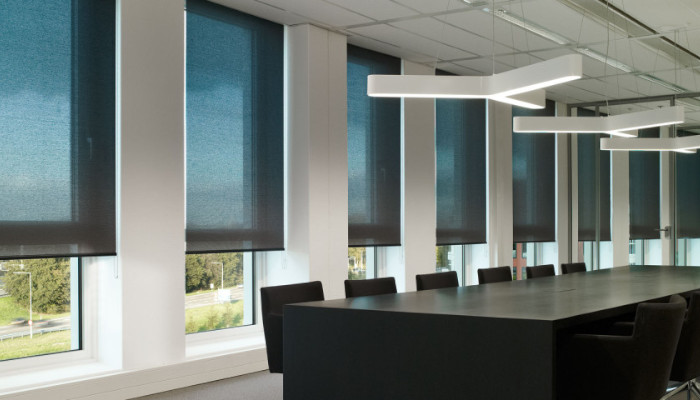
Envirotech Baritone
A revolutionary blind fabric made entirely from annually renewable plant-based sources. It’s strong, durable and offers excellent glare control, but with far less environmental impact.

Envirotech Baritone Metal
Baritone Metal takes everything that makes the original PLA-based Baritone fabric sustainable and enhances it with a metallised reverse for greater solar performance.
PVC-Free Blind Fabrics
PVC-free roller blind fabrics can be useful where material composition, indoor air quality or project-specific sustainability requirements are important.
The term PVC-free only describes one aspect of the fabric, so the wider specification still needs to be checked.
A suitable fabric should also meet the required standards for solar control, glare, light transmission, fire performance, durability and maintenance.
When reviewing PVC-free fabrics, check:
- whether the fabric has been tested for chemical emissions
- whether harmful-substance certification is available
- what material has been used instead of PVC
- supporting environmental documentation
- recyclability or end-of-life options
- solar and light-control data
- expected service life
- fire performance
Our EnviroScreen Optimum range is an example of a PVC-free fabric developed for commercial shading applications, with environmental and performance credentials that can support specification requirements.

EnviroScreen Optimum
Thanks to high reflectivity (74%), EnviroScreen Optimum lowers heating and cooling costs substantially. This results in a reduction of CO2 emissions, and therefore minimises the greenhouse effect.
Which Sustainability Certifications Matter?
Environmental certifications can help you check specific claims about a blind fabric, but they do not all assess the same thing.
Some focus on harmful substances. Others look at chemical emissions, material health, circularity or wider lifecycle impacts.
For specification purposes, it helps to understand what each certification actually covers.
|
Certification / Standard |
What it Assesses or Provides |
|---|---|
|
Cradle to Cradle Certified |
Material health, circularity and other sustainability criteria |
|
OEKO-TEX Standard 100 |
Testing for harmful substances |
|
GREENGUARD |
Chemical emissions into indoor air |
|
UK REACH |
Regulatory controls on chemicals |
|
Environmental Product Declaration (EPD) |
Verified lifecycle environmental data |
Cradle to Cradle Certified
Cradle to Cradle Certified assesses products across a range of environmental and material health criteria.
For blind fabrics, it can provide useful evidence around areas such as material composition, circularity and responsible manufacturing.
When specifying a certified fabric, check the current certification level, version and expiry status rather than relying on historic product literature.
OEKO-TEX Standard 100
OEKO-TEX Standard 100 confirms that a textile has been tested for harmful substances against defined criteria.
This can be useful where material health and occupant exposure are important, particularly in offices, healthcare, education and other regularly occupied spaces.
The certification relates to harmful substances in the textile. It should be considered alongside wider environmental and performance information.
GREENGUARD
GREENGUARD certification focuses on chemical emissions from products used within indoor environments.
It can help specifiers assess whether a blind fabric meets defined limits for volatile organic compound emissions and can be particularly relevant where indoor air quality forms part of the project brief.
GREENGUARD Gold uses stricter emission limits and is commonly considered for environments such as schools and healthcare facilities.
UK REACH
UK REACH regulates chemicals manufactured, imported and used in Great Britain.
For blind fabrics, this is relevant to the substances used within the material, coatings and manufacturing process.
UK REACH compliance should be treated as a regulatory requirement rather than an environmental certification in its own right.
Environmental Product Declarations
An Environmental Product Declaration, or EPD, provides independently verified information about the environmental impacts of a product across defined stages of its lifecycle.
Depending on the declaration, this can include information on:
- raw material impacts
- manufacturing
- transport
- energy use
- waste
- carbon emissions
- end-of-life scenarios
EPDs can be particularly useful for architects and sustainability teams carrying out lifecycle assessments or comparing products as part of BREEAM or wider environmental targets.
They do not provide a simple sustainability score. They provide data that can be used to make a more informed comparison.
Can Sustainable Blind Fabrics Support BREEAM, SKA and LEED?
Blind fabrics can support wider sustainability targets by contributing product information, material evidence and performance data required during building assessment.
Their value depends on the wider specification, the assessment method being used and the evidence available for the chosen product.
BREEAM
For UK projects, BREEAM is usually the most relevant assessment framework.
Blind fabric evidence may form part of wider project assessments covering materials, lifecycle impacts, indoor environmental quality and building performance.
The contribution will depend on the project, the BREEAM scheme and the assessment criteria being applied.
Read our guide to improving BREEAM performance with solar shading
SKA Rating
SKA Rating is focused on fit-out projects and can be relevant where sustainable materials and interior products form part of the project brief.
For blind fabrics, useful evidence may include material composition, recycled content, responsible sourcing, emissions data and supporting environmental certification.
The exact requirements will depend on the SKA scheme and project scope.
LEED
LEED may be relevant on international projects or UK projects working to a global sustainability framework.
Blind fabrics can form part of wider evidence around materials, indoor environmental quality and product transparency, particularly where Environmental Product Declarations, emissions testing or material ingredient information is available.
For all three systems, the safest approach is to check the current assessment criteria and provide the product evidence requested by the project sustainability team.
Sustainability Also Depends on Blind Performance
Environmental credentials are only part of the specification. A blind fabric also needs to control light and heat effectively within the building.
Key performance data to review includes:
- Solar transmittance: how much solar energy passes through the fabric
- Solar reflectance: how much solar energy is reflected away
- Solar absorption: how much solar energy is absorbed by the fabric
- Light transmission: how much daylight passes through
- Openness factor: the proportion of open area within a screen fabric
- Glare control: how effectively the fabric reduces direct and reflected glare
- Blackout or dimout performance: where tighter light control is required
- Fire performance: whether the fabric meets the required standard for the building
- Durability: whether the fabric is suitable for the expected level of use and cleaning
These factors affect comfort, daylight, glare and solar gain, so they should be considered alongside recycled content, certifications and material composition.
A metallised or highly reflective fabric may provide higher solar reflectance, while darker screen fabrics can often improve outward visibility and glare control.
The best choice depends on the orientation, glazing, room use and performance targets for the project.
Which Enviroscreen Sustainable Blind Fabrics Should You Consider?
Our sustainable blind fabric ranges use different approaches, including recycled polyester, plant-based materials, PVC-free construction and independently recognised certifications.
The best choice will depend on the environmental requirements of your project alongside solar control, openness, fire performance and the level of light control required.
|
Fabric |
Material / Environmental Features |
Key Performance Characteristics |
|---|---|---|
|
Envirotech Baritone |
100% polylactic acid (PLA) biopolymer, mechanically recyclable, Cradle to Cradle certified |
3% openness factor |
|
Envirotech Baritone Metal |
100% PLA biopolymer, mechanically recyclable, Cradle to Cradle certified |
3% openness with metallised solar-control finish |
|
Envirotech Soprano |
Made from 100% recycled PET bottles, Cradle to Cradle certified |
1% and 3% openness, fire retardant and antimicrobial |
|
Envirotech Soprano Metal |
Made from 100% recycled PET bottles, Cradle to Cradle certified |
3% openness with metallised solar-control finish |
|
EnviroScreen Optimum |
100% PES inherent FR, PVC and formaldehyde free, OEKO-TEX, GREENGUARD Gold and Cradle to Cradle Bronze |
Metallised, 74% solar reflectance and strong glare control |
|
Harmony Blackout |
100% recycled polyester, OEKO-TEX Standard 100 |
Blackout fabric with white backing and fire-retardant performance |
|
Harmony Dimout |
100% recycled polyester, OEKO-TEX Standard 100 |
Dimout, fire retardant and IMO certified |
|
Harmony Screen Whiteback |
85% recycled polyester, OEKO-TEX Standard 100 |
1% and 3% openness with reflective white backing |
These ranges cover different shading requirements, so material content should be considered alongside the technical performance needed for each façade and internal space.
You can compare our full fabric range by environmental credentials, openness, solar performance, shading type and other technical properties using the Blind Fabric Specifier Tool.
Use the Blind Fabric Specifier Tool
If you already know the performance requirements for your project, our Blind Fabric Specifier Tool can help you narrow down suitable options.
You can compare fabrics by criteria including:
- environmental credentials
- solar reflectance
- solar absorption
- openness factor
- shading type
- certification
- room use
- colour
This is useful when you need to balance sustainability with practical requirements such as glare control, solar gain, privacy and light transmission.
Sustainable Blind Fabric Specification Checklist
Before you specify a blind fabric, check both its environmental credentials and its technical suitability for the building.
Material and environmental information
- What is the fabric made from?
- Does it contain recycled material?
- Does it contain renewable or bio-based material?
- Is it PVC-free if this is a project requirement?
- Is the fabric recyclable?
- Is there a defined take-back or end-of-life route?
- Is an Environmental Product Declaration available?
- Are current certification documents available?
- Does the product comply with UK REACH requirements?
- Has the fabric been tested for harmful substances or chemical emissions?
Performance requirements
- What openness factor is required?
- What solar and visible light performance does the glazing require?
- Is blackout or dimout performance required?
- Is glare control a priority?
- Does the fabric meet the required fire performance?
- Is the fabric suitable for the expected level of use and cleaning?
Project requirements
- What is the orientation of the glazing?
- How exposed is the façade to direct sunlight?
- What is the room used for?
- Is outward visibility important?
- Are there specific BREEAM, SKA, LEED or client sustainability requirements?
- Does the project team need supporting certificates, technical data or lifecycle information?
Using the same checklist across shortlisted fabrics makes it easier to compare products on a consistent basis.
You can also use our Blind Fabric Specifier Tool to compare suitable fabrics by environmental and performance criteria.
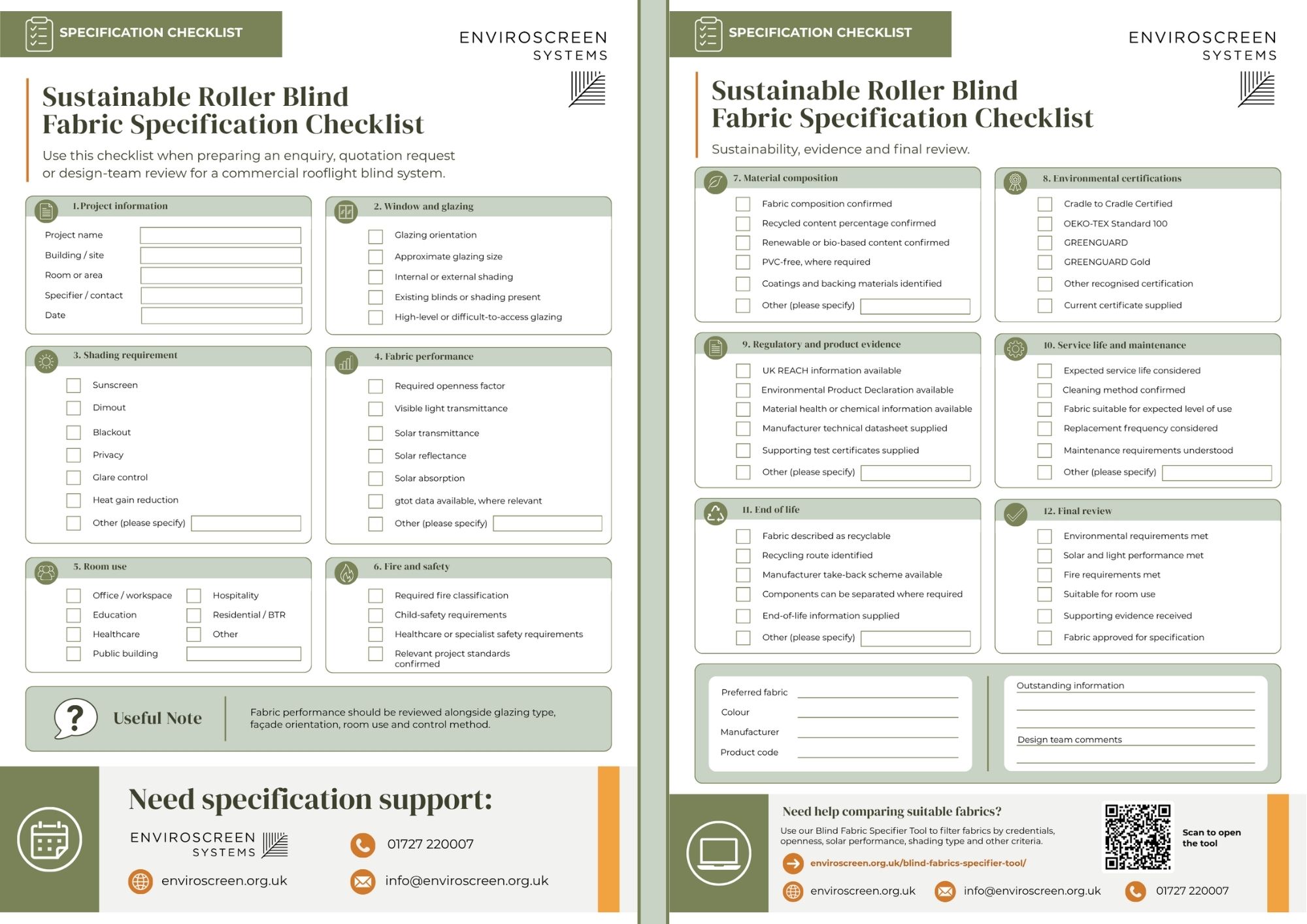
And use our interactive Sustainable Roller Blind Fabric Specification Checklist to review material composition, environmental credentials, solar performance, fire requirements and supporting evidence before you specify a fabric.
The printable version can be downloaded here.
Choosing a Sustainable Blind Fabric for Your Project
The right fabric will depend on the building, glazing, room use and environmental requirements of the project.
Before making a final choice, review:
- solar and glare control requirements
- openness and outward visibility
- blackout or dimout needs
- fire performance
- material composition
- environmental certifications
- durability and cleaning
- end-of-life options
- any BREEAM, SKA, LEED or client-specific requirements
You can compare suitable options using our eco-friendly blind fabric range.
If you need help matching environmental targets with solar, light and fire performance, we can also help you review the specification requirements for your project.

FAQs for Sustainable Blind Fabrics
What makes a roller blind fabric sustainable?
A sustainable roller blind fabric should be assessed across several areas, including raw materials, recycled or renewable content, chemical composition, manufacturing, durability, technical performance and end-of-life options.
Independent certification and supporting technical documentation can help you verify specific claims.
Are recycled polyester roller blinds sustainable?
Recycled polyester can reduce demand for virgin polyester by using material that has already been processed, often from post-consumer PET.
Its overall suitability still depends on factors such as durability, manufacturing, fire performance, solar performance and whether supporting environmental evidence is available.
What is the difference between recycled, recyclable and renewable blind fabric?
Recycled means the fabric contains material that has already been used and processed into a new product.
Recyclable means the material may be capable of being processed again at the end of its service life.
Renewable refers to material sourced from resources that can be replenished, such as plant-based feedstocks.
Are PVC-free blind fabrics more sustainable?
PVC-free fabrics can be useful where material composition, indoor air quality or project sustainability requirements are important.
You should still review the wider specification, including the replacement material, chemical emissions, durability, fire performance, solar control and end-of-life options.
What is the difference between OEKO-TEX and GREENGUARD?
OEKO-TEX Standard 100 focuses on harmful substances within the textile.
GREENGUARD focuses on chemical emissions released from products into indoor air.
Both can be useful, but they assess different aspects of a fabric’s environmental and health profile.
Can sustainable blind fabrics support BREEAM?
They can support wider BREEAM objectives where the project requires evidence around materials, lifecycle assessment, indoor environmental quality or building performance.
The exact contribution depends on the BREEAM scheme, project criteria and supporting documentation available for the selected fabric.
For enquiries about sustainable fabrics:
Enviroscreen Systems
Swift House,
13 Ronsons Way,
St Albans,
AL4 9QT
United Kingdom
Telephone: 01727 220 007
E-mail: info@enviroscreen.org.uk