Antimicrobial Fabrics for Blinds and Curtains: A Specifier’s Guide
Antimicrobial fabrics can help support hygiene and infection-control procedures in healthcare and other hygiene-sensitive environments.
For blinds and curtains, the fabric also needs to meet the practical requirements of the room.
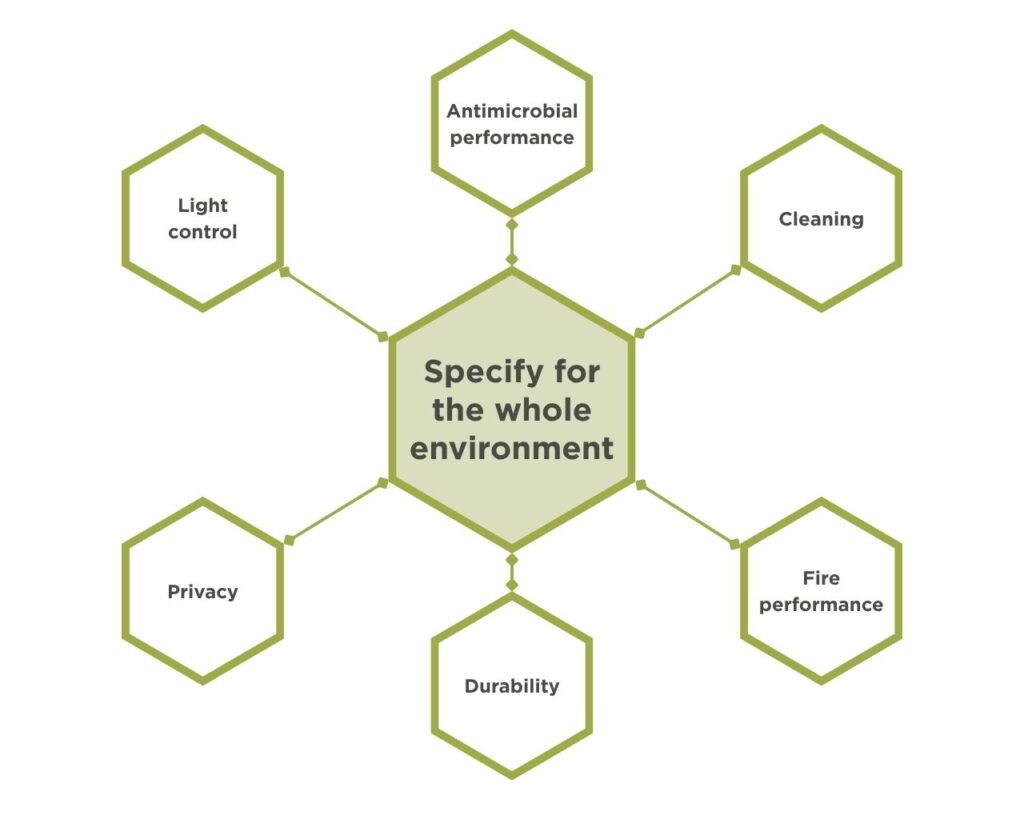
You may also need to consider how easily it can be cleaned, whether it can withstand repeated laundering or disinfecting, its fire performance, durability, privacy and light-control properties.
This guide explains what antimicrobial fabric means, how it differs from antibacterial fabric and what you should consider when specifying blinds and curtains for healthcare environments.
What Is Antimicrobial Fabric?
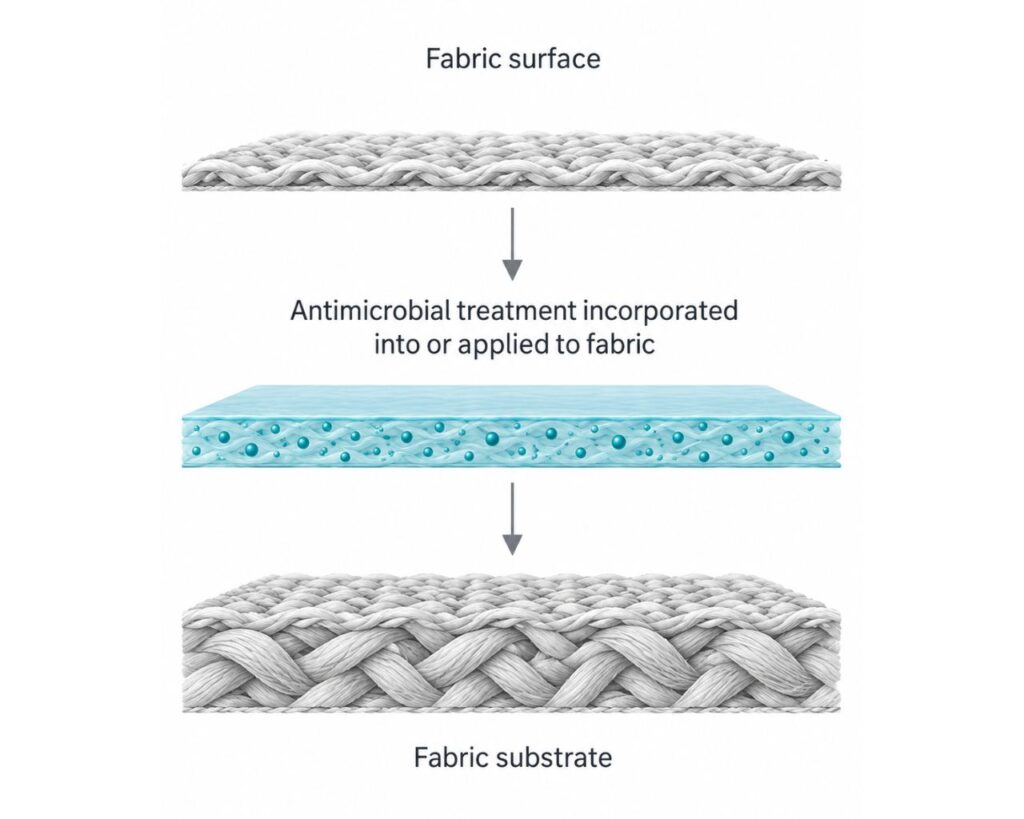
Antimicrobial fabric is designed to inhibit the growth of specified microorganisms on the fabric surface.
This performance may come from properties inherent in the material, a treatment incorporated during manufacture or a coating or finish applied to the fabric.
The term antimicrobial does not tell you exactly which microorganisms a fabric has been tested against. Performance can vary considerably between products.
When reviewing an antimicrobial blind or curtain fabric, check:
- Whether repeated cleaning or laundering affects its performance
- Which microorganisms it has been tested against
- How the antimicrobial treatment is incorporated
- The manufacturer’s supporting technical data
- The test method or standard used
For specification purposes, the test evidence behind the antimicrobial claim is more useful than the antimicrobial label on its own.
What Is the Difference Between Antimicrobial and Antibacterial Fabric?
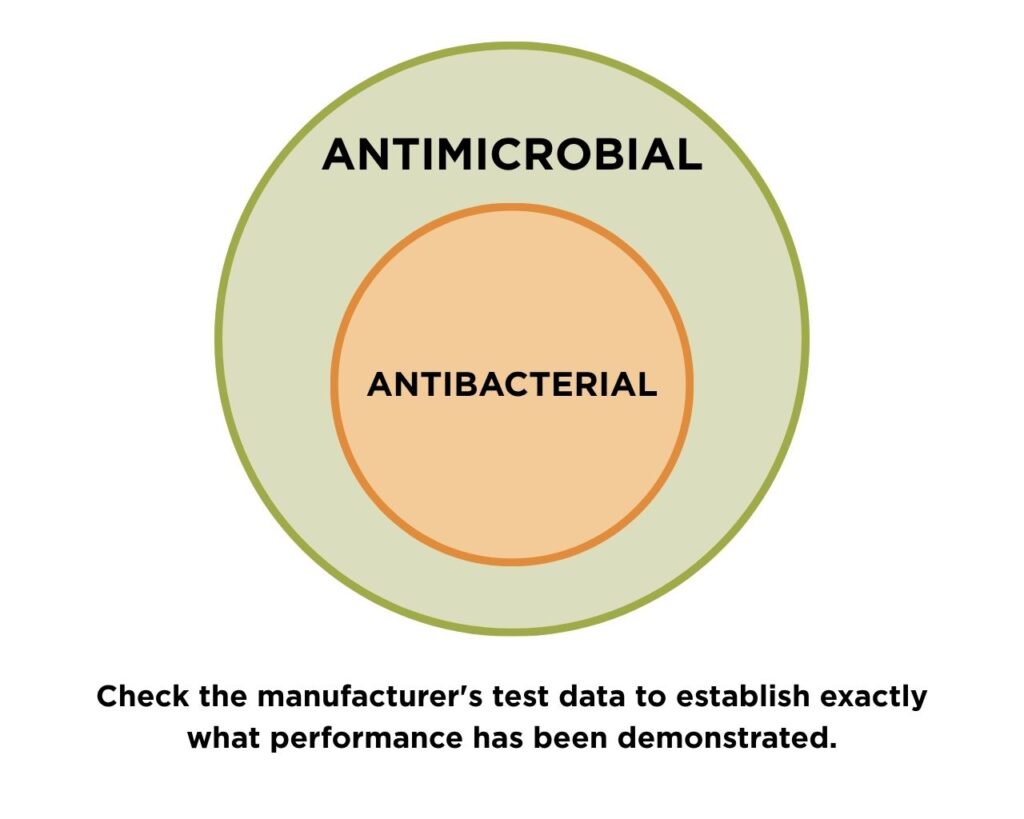
Antibacterial fabric is designed to inhibit the growth of bacteria.
Antimicrobial is a broader term and can apply to different types of microorganisms, depending on the treatment used and the performance demonstrated through testing.
A fabric described as antimicrobial should therefore not automatically be assumed to provide proven performance against bacteria, viruses, mould and fungi.
If this performance is important to your project, check the manufacturer’s technical information to establish which organisms have been tested and under which conditions.
This is particularly important in healthcare environments, where broad antimicrobial claims should be supported by appropriate evidence.
Why Fabric Choice Matters in Healthcare Environments
Blinds and curtains in healthcare settings can be exposed to frequent handling, regular cleaning and demanding day-to-day use.
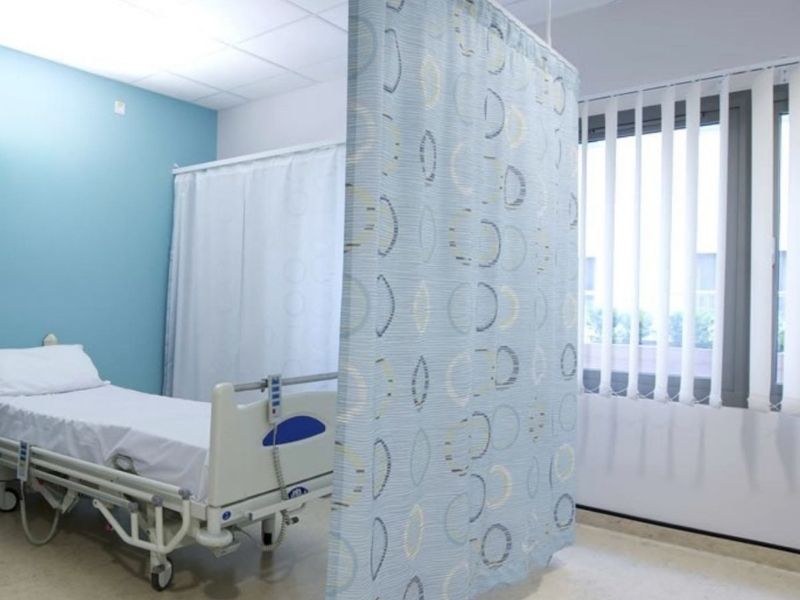
Privacy curtains may also be touched repeatedly by patients, visitors and clinical staff. NHS healthcare guidance recognises that privacy curtains can become contaminated with microorganisms and recommends that reusable curtains are suitable for healthcare laundering.
It also advises against window blinds that are difficult to clean.
This means fabric selection should consider how the product will perform throughout its service life.
For example, a roller blind in a treatment room may need to be easy to clean and resistant to moisture while still providing suitable glare and privacy control.
A cubicle curtain may need to withstand repeated handling and laundering while meeting the project’s privacy, durability and fire-performance requirements.
Selecting the right fabric therefore depends on the room, cleaning regime and required performance of the complete blind or curtain system.
What Should You Look for When Specifying Antimicrobial Fabrics?
An antimicrobial claim is only one part of the specification.
The fabric also needs to suit the room, the cleaning regime and the performance required from the blind or curtain throughout its service life.
When comparing fabrics, check the supporting technical information for each of the following:
|
Specification point |
What you should check |
|---|---|
|
Antimicrobial performance |
Which microorganisms has the fabric been tested against? |
|
Test evidence |
What test method or standard supports the manufacturer’s claim? |
|
Cleaning compatibility |
Which cleaning products and disinfectants can be used without damaging the fabric? |
|
Washability |
If the curtain is reusable, can it withstand the required laundering process? |
|
Treatment durability |
Is the antimicrobial performance maintained after repeated cleaning or laundering? |
|
Fire performance |
Does the fabric meet the fire requirements for the project and application? |
|
Moisture resistance |
Is it suitable for humid areas or environments subject to frequent cleaning? |
|
Durability |
Can it withstand repeated handling and regular use? |
|
Privacy |
Does it provide the level of screening, dimout or blackout required? |
|
Light control |
For blinds, does it provide the required daylight and glare control? |
|
Replacement |
Can curtains, blinds or individual components be removed and replaced efficiently? |
|
Documentation |
Are current technical datasheets, test reports and certificates available? |
The importance of each factor will depend on the room.
A patient bay, treatment room, waiting area and laboratory can all require different combinations of hygiene, privacy, light control and durability.
Assessing these requirements together helps you select a fabric suited to the complete application.
Antimicrobial and Wipe-Clean Blind Fabrics
For blinds used in healthcare and other hygiene-sensitive environments, cleanability should be considered from the start.
The terms antimicrobial, wipe-clean and moisture resistant describe different characteristics.
Antimicrobial performance relates to the fabric’s tested ability to inhibit specified microorganisms.
Wipe-clean describes a surface that can be physically cleaned using an appropriate method and cleaning product.
Moisture resistance indicates whether the fabric is suitable for conditions where it may be exposed to humidity or moisture.
A fabric can offer more than one of these properties, but one should not be assumed from another.
You should also consider what the blind needs to achieve at the window.
In a healthcare environment this could include reducing glare, maintaining useful daylight, providing privacy or controlling solar gain.
An Example: Envirotech Solo
Our Envirotech Solo screen fabric incorporates Biosafe® technology and is specified by Enviroscreen as an antimicrobial/antibacterial healthcare fabric.
It is available with 1% or 3% openness, allowing you to select the level of screening according to the daylight and glare requirements of the space.
This makes it suitable where you need to combine hygiene-related fabric properties with practical solar and glare control.

Envirotech Solo
A uniquely stylish and popular fabric that offers diverse performance characteristics. Whilst reducing solar glare, the comfort of natural light is still maintained.

Envirotech Solo Blackout
This fabric is designed for areas where a high level of light exclusion is required along with exceptional performance characteristics.
Antimicrobial Curtains and Healthcare Privacy Curtains
Healthcare curtains have different demands from window blinds.
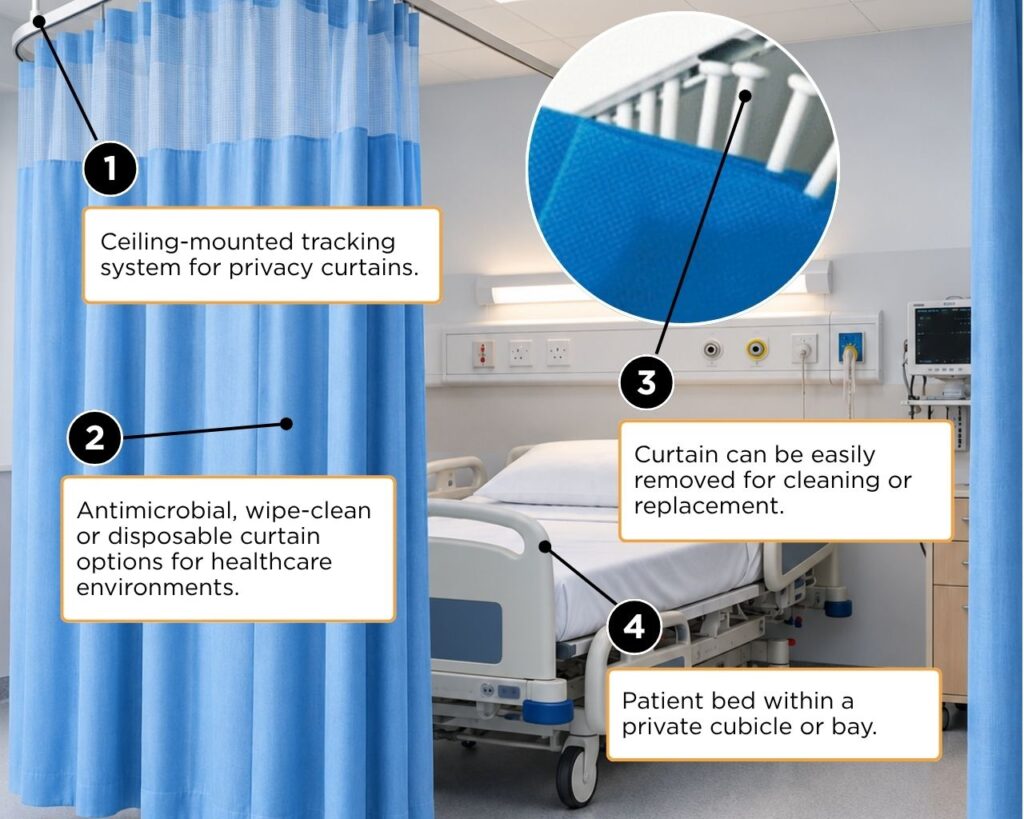
Cubicle and privacy curtains can be handled frequently by patients, visitors and staff, so the cleaning method, replacement procedure and durability of the fabric all need to be considered.
Depending on the application, you may need to assess:
- Antimicrobial properties and supporting test evidence
- Compatibility with the required cleaning process
- Laundering requirements for reusable curtains
- Compatibility with the curtain tracking system
- Ease of removal and replacement
- Resistance to repeated handling
- Fire performance
- Privacy
The curtain and track should also be considered as a complete system.
A fabric may meet the required performance criteria, but the way the curtain is fitted, removed, cleaned and replaced will affect how practical the system is to manage day to day.
We supply antimicrobial, wipe-clean and disposable curtain options for healthcare environments, alongside cubicle and privacy tracking systems that can be configured for different ward, treatment and clinical layouts.

Blinds

Curtains

Tracking Systems
Reusable or Disposable Healthcare Curtains?
Both reusable and disposable curtains can be suitable for healthcare environments. The right choice depends on the clinical setting, cleaning procedures, replacement programme and operational requirements.
|
Reusable curtains |
Disposable curtains |
|---|---|
|
Designed for repeated use |
Designed around planned replacement |
|
May require healthcare laundering or another specified cleaning process |
Usually replaced rather than laundered |
|
Fabric durability is important |
Quick removal and replacement are important |
|
Requires an established cleaning and change programme |
Requires replacement stock and disposal planning |
|
Performance needs to withstand repeated cleaning |
Performance needs to remain suitable throughout the intended use period |
For reusable curtains, check how the fabric should be cleaned or laundered and whether repeated treatment affects its fire or antimicrobial performance.
For disposable curtains, consider how frequently they need to be changed, how replacement stock will be managed and how easily staff can remove and fit new curtains.
The most suitable approach should be based on the requirements of the individual healthcare environment and its infection prevention and control procedures.
[Read our guide to disposable vs reusable healthcare curtains]
Do Antimicrobial Blinds and Curtains Still Need Cleaning?
Yes. Antimicrobial properties work alongside the cleaning, laundering and replacement procedures required for the environment.
In healthcare settings, blinds and curtains should be selected with the cleaning regime in mind.
NHS guidance (HBN 00-09) states that healthcare environments should be designed so they are easy to clean and maintain, while blinds that are difficult to clean are not recommended.
Before specifying a fabric, check:
- Whether repeated cleaning affects the antimicrobial treatment
- Whether reusable curtains require healthcare laundering
- Whether disinfectants are compatible with the material
- Any recommended washing or drying temperatures
- When curtains or blinds should be replaced
- How often the fabric should be cleaned
- Which cleaning products can be used
The cleaning method should always follow the manufacturer’s instructions and the procedures set for the individual healthcare facility.
NHS England’s current infection-control guidance also requires healthcare environments to be routinely cleaned in accordance with the National Standards of Healthcare Cleanliness.
Other Fabric Performance Requirements You Should Consider
Antimicrobial performance is one part of the specification. Your blind or curtain still needs to perform effectively within the room where it will be installed.
Fire Performance
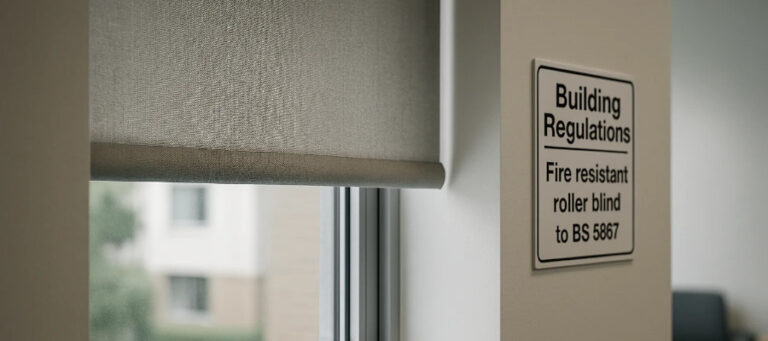
Fire performance can be particularly important when specifying curtains and blinds for commercial and healthcare buildings.
The required standard will depend on the product, application and project specification. BS 5867-2 covers flammability requirements for curtain and drape fabrics and is commonly referenced in UK commercial specifications.
Check the current test certificate for the specific fabric rather than assuming that all fabrics within a product range have the same classification.
[Read our guide to UK fire safety rules for blinds and curtains]
Light and Glare Control
Healthcare blinds often need to manage daylight as well as provide an appropriate level of privacy.
Depending on the room, you may need to consider:
- Solar control
- Glare reduction
- Fabric openness
- Visible light transmission
- Maintaining outward views
- Dimout or blackout requirements
A patient room may require a different level of light control from a consultation room, office or clinical treatment space.
[Read our guide to choosing the right fabric for solar shading]
Privacy and Blackout
Privacy requirements vary considerably across healthcare buildings.
Treatment rooms, consultation areas and patient bedrooms may require effective visual screening, while diagnostic or specialist rooms can require higher levels of light exclusion.
Consider the fabric alongside the complete blind or curtain system.
Gaps around the edges, tracking arrangements and installation details can all affect the level of privacy or blackout achieved.
Durability
Healthcare blinds and curtains may be operated and handled many times each day.
Fabric durability therefore needs to be considered alongside:
- Movement through tracking systems
- Expected replacement intervals
- Moisture exposure
- Repeated cleaning
- Frequency of use
- Laundering
Choosing a fabric that is appropriate for the level of use can help reduce premature replacement and ongoing maintenance requirements.
Sustainability
Environmental requirements can also influence fabric selection.
When comparing products, you may want to consider:
- Manufacturing information
- Environmental certification
- Frequency of replacement
- Material composition
- Expected service life
- Recycled content
- Recyclability
These factors should be considered alongside hygiene, cleaning and performance requirements.
[Read our guide to environmentally friendly blind fabrics]
Where Are Antimicrobial Blinds and Curtains Used?
Antimicrobial and easy-clean fabrics are most useful where hygiene, regular cleaning and durability are important parts of the specification.
Hospitals and Healthcare
Typical applications include patient bedrooms, wards, treatment rooms, consultation areas, outpatient departments and health centres.
In these settings, blinds and curtains may need to support regular cleaning while also providing privacy, glare control, durability and appropriate fire performance.
Clinics and Treatment Environments
Dental practices, specialist clinics and treatment rooms can also benefit from fabrics that are easy to maintain and suitable for repeated cleaning.
Blind and curtain specifications may need to combine hygiene-related properties with privacy, daylight control and resistance to moisture.
Education and Other High-Use Spaces
Certain schools, laboratories, washrooms, changing areas and other frequently used spaces may also require robust, easy-clean fabrics.
The final choice should reflect the room, cleaning regime, level of use and the wider performance requirements of the blind or curtain system.
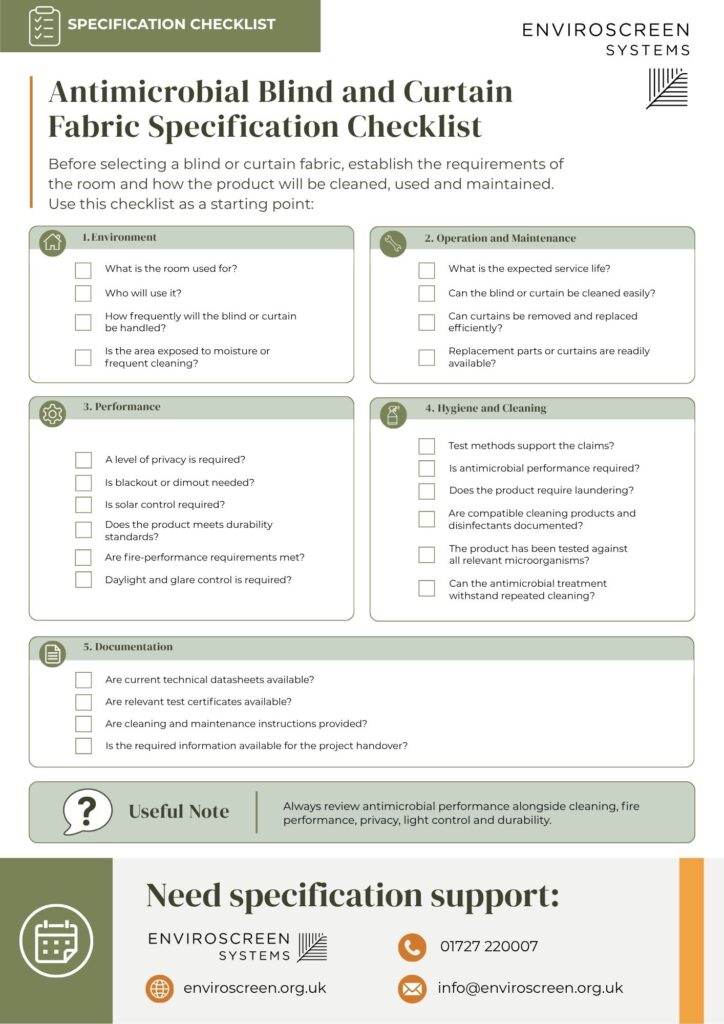
Antimicrobial Blind and Curtain Fabric Specification Checklist
Before selecting a blind or curtain fabric, establish the requirements of the room and how the product will be cleaned, used and maintained.
Use this checklist as a starting point:
Environment
- What is the room used for?
- Who will use it?
- How frequently will the blind or curtain be handled?
- Is the area exposed to moisture or frequent cleaning?
Hygiene and Cleaning
- Is antimicrobial performance required?
- Which microorganisms has the product been tested against?
- What test method supports the claim?
- Which cleaning products and disinfectants are compatible?
- Does the product require laundering?
- Can the antimicrobial treatment withstand repeated cleaning?
Performance
- What level of privacy is required?
- Is blackout or dimout needed?
- What level of daylight and glare control is required?
- Is solar control required?
- What fire-performance requirements apply?
- How durable does the product need to be?
Operation and Maintenance
- How easily can the blind or curtain be cleaned?
- Can curtains be removed and replaced efficiently?
- Are replacement parts or curtains readily available?
- What is the expected service life?
Documentation
- Are current technical datasheets available?
- Are relevant test certificates available?
- Are cleaning and maintenance instructions provided?
- Is the required information available for the project handover?
[View our Antimicrobial Blind & Curtain Fabric Specification Checklist]
Specifying Blinds and Curtains for Healthcare Projects
Choosing a healthcare blind or curtain involves balancing hygiene, cleaning, privacy, light control, durability and project-specific performance requirements.
We work with architects, contractors, designers and estates teams to help select suitable blinds, curtains, fabrics and tracking systems for healthcare environments.
Our support can include fabric selection, technical information, samples, system design and installation, with solutions tailored to the individual room and project requirements.
Whether you are specifying a new healthcare development, refurbishing an existing facility or replacing blinds and curtains across an estate, we can help you review the available options.
Frequently Asked Questions
What is antimicrobial fabric?
Antimicrobial fabric incorporates a material, treatment or finish designed to inhibit the growth of specified microorganisms on the fabric surface.
The exact performance depends on the individual product and its supporting test data, so you should always check which microorganisms have been tested.
What is the difference between antimicrobial and antibacterial fabric?
Antibacterial refers specifically to activity against bacteria.
Antimicrobial is a broader term, but it does not automatically mean that a fabric has demonstrated performance against every type of microorganism.
Check the manufacturer’s test documentation to establish what has actually been tested.
Do antimicrobial blinds still need regular cleaning?
Yes. Antimicrobial properties should form part of a wider cleaning and maintenance programme. The blind still needs to be cleaned using methods and products that are suitable for the fabric and the environment.
Can antimicrobial curtains be washed?
Some can, but laundering requirements vary between products.
For reusable healthcare curtains, check the manufacturer’s washing instructions and establish whether repeated laundering affects the fabric’s antimicrobial, fire or physical performance.
NHS guidance states that reusable healthcare curtains should be capable of withstanding healthcare laundering processes.
Are antimicrobial fabrics effective against viruses?
That depends on the individual product.
An antimicrobial description alone does not demonstrate antiviral performance. If protection against a particular virus or other microorganism is required, look for specific test evidence supporting that claim.
What should I look for in a healthcare blind fabric?
Consider cleanability, compatibility with cleaning products, durability, moisture resistance, fire performance, privacy, glare and daylight control.
You should also check that current technical data and relevant test certificates are available.
Are wipe-clean and antimicrobial fabrics the same?
They describe different properties.
A wipe-clean fabric is designed so its surface can be physically cleaned using an appropriate method. Antimicrobial performance relates to the fabric’s tested interaction with specified microorganisms. Some fabrics offer both properties., improve your infection control and reduce the most common sources of illness?
For Enquiries About Blind Fabrics:
Enviroscreen Systems
Swift House,
13 Ronsons Way,
St Albans,
AL4 9QT
United Kingdom
Telephone: 01727 220 007
E-mail: info@enviroscreen.org.uk