Vertical Louvre Blinds or Curtains?
Choosing the ideal solar shading solution for your windows involves a multitude of alternatives and can be quite a daunting task.
When deciding how to dress a window, there are many considerations to think about.
For many, it comes down to personal style, although the favourite option could have a big influence on the overall appearance of a room.
For example, a room with several windows may look overwhelmed with full curtains, so blinds are often the recommended solution.
Choosing between blinds and curtains can be one of the most difficult decisions in solar shading, as functionality, composition and maintenance play an equal role to design and aesthetics.
Functionality includes privacy, controlling the flow of light, keeping heat in and keeping draughts out.
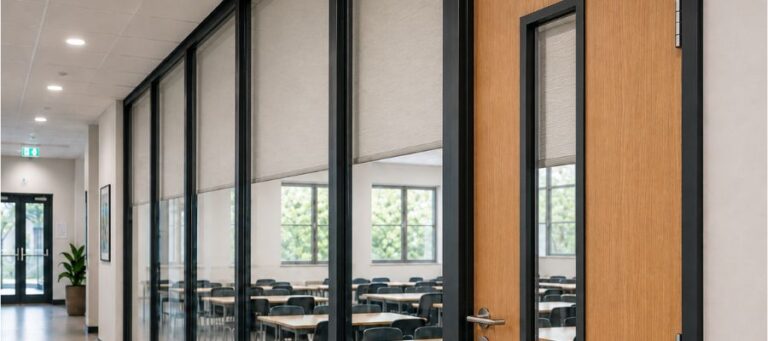
In office environments, blinds or curtains can be an effective way of improving acoustic performance, helping to reduce staff discomfort caused by poor acoustics.
Vertical Louvre Blinds
In general, blinds are extremely practical because they can filter the amount of external light entering a room.
Vertical blinds are exceptional at this and still provide an acceptable level of privacy.
Vertical blinds are also a good option for covering wide windows in a single blind.
Modern homes and offices are adopting vertical blinds due to their wide range of fabrics and materials, easy maintenance and suitability for most budgets.
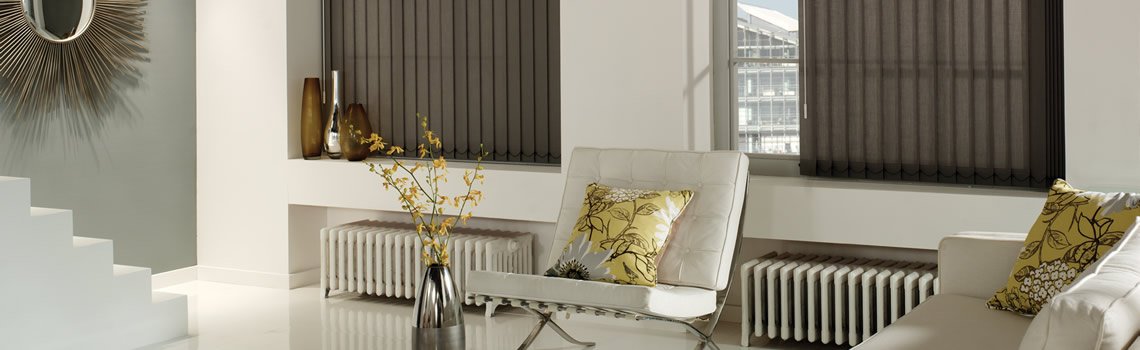
Many blind fabrics offer substantial energy efficiency, as they have reflective properties that can reduce heat gain from the sun.
They can also be tightly fitted to the window cavity so they do not cut off heat sources such as radiators.
There are several acoustic fabrics that can have a significant impact on reducing echo, as well as providing protection from heat and glare.
Light control is excellent with vertical blinds.
Whether you want to change the lighting conditions or create some privacy, it’s just the pull of a control chain, twist of a wand or use of a remote control to get the required ambience.
Rooms can be kept bright while retaining privacy by tilting the louvres in the right direction.
Dedicated privacy blinds are mounted as close to the glazing as possible within the window opening.
Blackout fabric will provide room darkening, although there could still be light leakage between vertical louvres and around the edges.
Control of vertical blinds is also a benefit, as they can have controls on either side.
They can be made to pull to one side or split in the middle like curtains.
The louvres can be changed if the colour scheme is changed, at a fraction of the cost of buying and installing a new blind.
Headrails also come in a variety of colours.
They are easy to clean and do not collect dust, so maintenance is minimal and durability is high.
For these reasons, vertical blinds are particularly favourable in offices and modern homes.
They give an elegant, luxurious touch to window dressing and work well if the windows are uncommonly wide or long, or if several windows are grouped together.

Reasons to Choose Blinds
- Very good light filtration as standard, exceptional with block-out materials
- Easily fitted to the window recess, so ideal for limited space
- Easy to maintain and clean
- Inexpensive to replace damaged panels
- Wide range of materials, including wood and vinyl
- Versatile, as panels can be moved completely to the side or tilted to vary light ingress
- More affordable than curtains
- Can offer good energy-saving benefits
- Best option for kitchens and bathrooms
Curtains
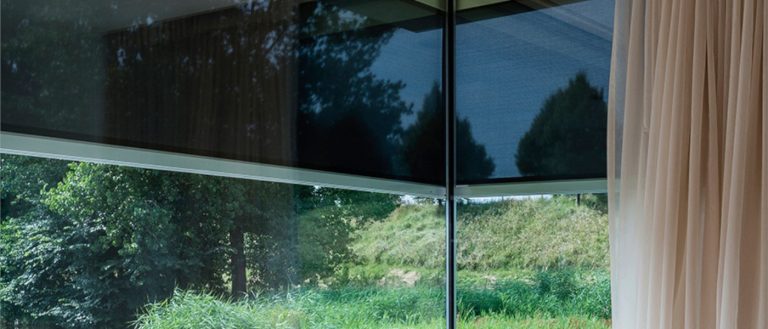
Curtains come in a vast array of styles, with a range of fabrics suitable for just about any interior.
They can completely block out light and add warmth in the cooler months.
With a soft, gentler fabric, they can create a chic and opulent look that sways with the breeze when the window is open.
Curtains have a charm and character of their own.
Even though they are a classic option, they are an effective way of blocking sunlight and ensuring maximum privacy.
The homely ambience they create is always a favourite for accommodation settings.
Thick material is ideal for reducing draughts from windows.
Blackout linings would be the ultimate solution for creating a dark room, as there are very few light gaps compared to other solar shading products.
Curtains generally provide better blackout efficiency than blinds because they are mounted outside the window opening, overlap on either side and the fabric hangs snug against the walls.
Curtains also have the widest range of textures, designs and colours, so they will always be a popular choice for home decorating and interior design.
Traditional aesthetics favour curtains to show wealth and opulence.
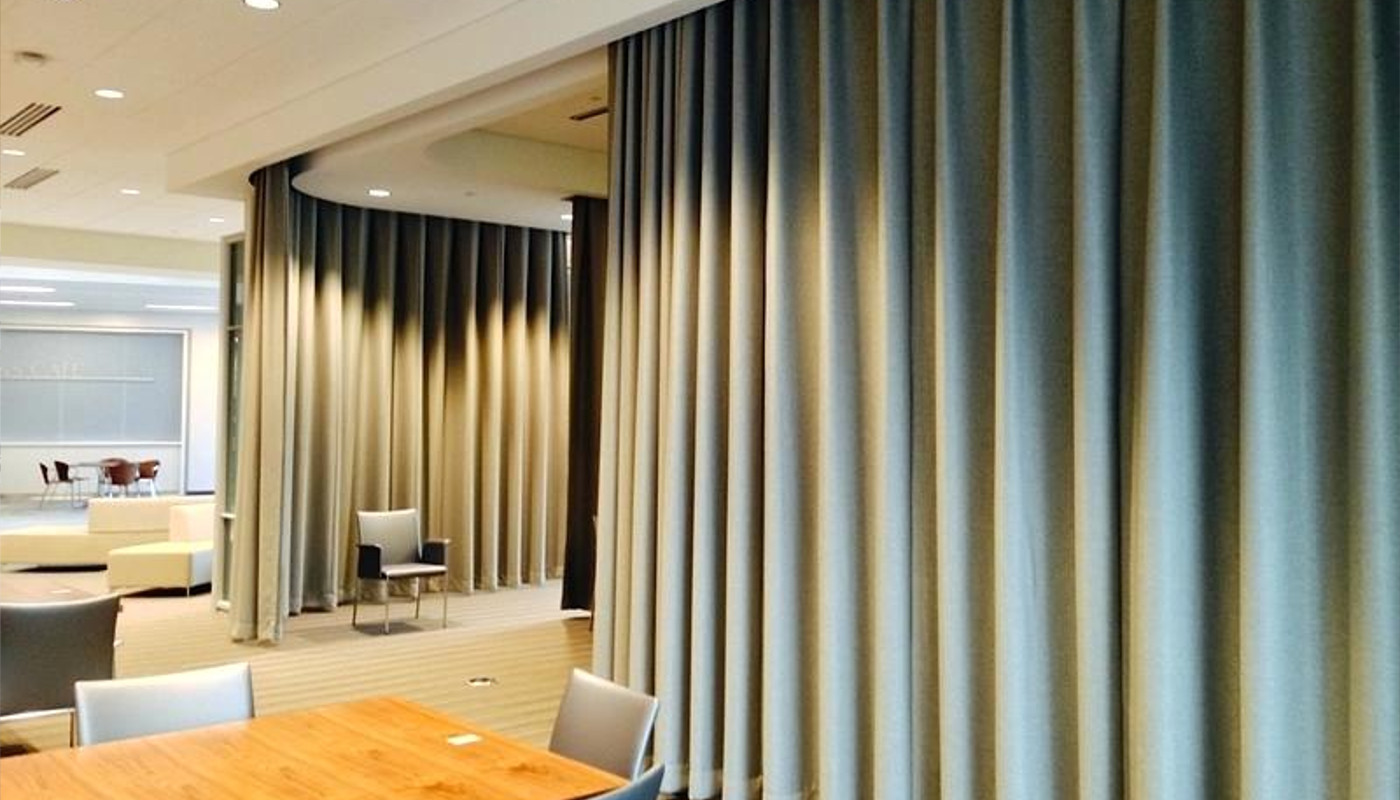
Some boardrooms may still install them for a luxurious feel and improved acoustics, typically in a heavy wool serge or velvet.
They can also be used as room dividers or to create an acoustic or visual partition.
Curtains have long been used in theatres for this purpose.
The fullness of the curtain usually affects the acoustic properties, but recent advances in fabric manufacturing mean lightweight sheer and voile materials can offer similar performance.
Reasons to Choose Curtains
- Most effective at blocking sunlight
- Gives a room a cosier ambience
- Wide range of colours, patterns, fabric types and designs
- Wide range of linings, interlinings and headings
- Less likely to get damaged
- Safer around children
- More effective at keeping draughts out and warmth in
- Different thickness options for various conditions
- Suitable for night-time privacy
- More sound absorbent
Which is Best, Blinds or Curtains?
The answer to this question depends on many factors, including personal preference.
There is always the option to have both.
Blinds can be used to control light, while the curtains function as a window dressing and provide extra insulation when needed.
This way, the benefits of both options can be achieved.
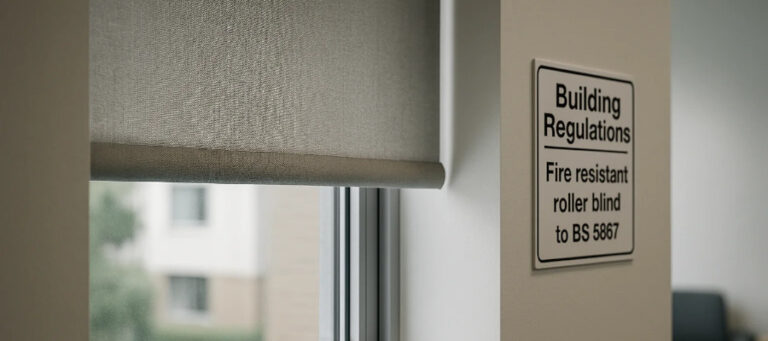
Any contract blinds or curtains installed must adhere to the BS5867 Fire Safety Standards.
There are 3 levels of durability depending on how the material is affected by the laundering process during the life of the product.
Both vertical blinds and curtains can be a feature in their own right in your offices, or they can work seamlessly into a room’s interior.
It’s all about the look and style you want, and what you want from your window treatments.
The biggest advantage vertical blinds have over curtains is that they are usually less expensive and simpler to install.
They also use less fabric for the softer blinds and have a more modern look.
They reveal much more space than curtains and can be fixed either within the window recess or outside the frame.
Pairing curtains and blinds is a popular option to consider, particularly in areas such as bay windows or French windows, and in place of voile curtains in bedrooms.

For Enquiries About Blinds and Curtains:
Enviroscreen Systems
Swift House,
13 Ronsons Way,
St Albans,
AL4 9QT
United Kingdom
Telephone: 01727 220 007
E-mail: info@enviroscreen.org.uk